Kitchen Aeration Holes
Why are aeration holes necessary?
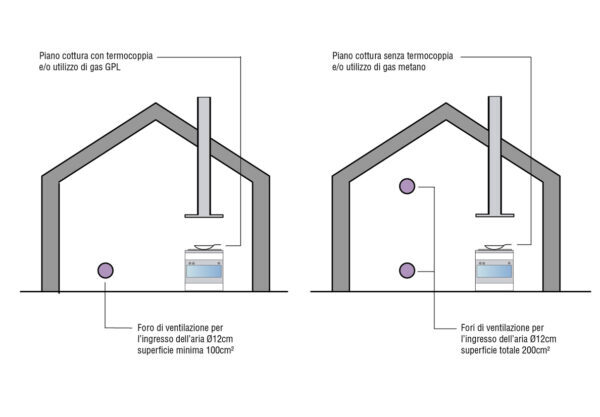
The quantitiy of air that enters the kitchen must be at least equal to the air used for normal gas combustion. In addition to this, one must consider that without a flow of air from outdoors, hood extraction may generate a drop in pressure that would prevent the complete expulsion of fumes. To avoid these two problems the air flow must come in directly through permanent openings on the outside walls of the kitchen. These openings are governed by the UNI7129 standards and must comply with the following requirements:
– they must have a net cross-section of at least 6cm for each kW of heat capacity installed, with a minimum of 100cm2;
– if the hob does not have a thermocouple (device that stops the gas flow if the flame goes out) an additional hole is required to obtain a minimum aeration cross-section of 200cm2.
It is recommended to make the second vent opening in the lower part of the room, since LPG, having a higher relative density than methane, tends to accumulate towards the bottom and requires a greater air supply for combustion.
Standards also allow indirect ventilation by taking air from an adjacent room, as long as this room is ventilated directly from outdoors, is not a bedroom and is not at a high risk of catching fire (e.g. a carport, a garage, a warehouse etc.).
In addition to this, the adjacent room must not have a lower pressure compared to the room to be aired because of the presence of an appliance powered by any type of fuel (e.g. a fireplace, a stove, etc.) or of an extraction device for which an air inlet has not been provided. The air can flow in from the adjacent room through permanent openings or, if a door divides the two rooms, it can enter by increasing the gap between the door and the floor (min. 2 cm).
Where possible, Valcucine suggests to make the aeration holes in a room adjacent to the kitchen to avoid annoying cold air draughts (before reaching the kitchen the air has time to warm up) and to prevent odours from going towards other rooms in the home by conveying them in the right direction.